That beat from Afrika Bambaataa's "Planet Rock" on which a chunk of early hip hop and electro was built? Bambaataa didn't invent it. The rhythmic pattern from "Nummern" and the melody from "Trans Europa Express" formed the sampled backbone of "Planet Rock", and that track gave birth to the entire electro genre. So he borrowed the loop from four Germans in Düsseldorf. They are called Kraftwerk, and you may not know their name, but you hear their DNA on the radio almost every day. If the search term Kraftwerk Prague brought you here, you'll find out why this band ranks among the most influential in history and what to expect at one of their concerts.
And one more small detail at the start that will make you like them. The refrain "fahren, fahren, fahren" from their breakthrough track was long confused by the world with "fun, fun, fun" by the Beach Boys. Kraftwerk are actually singing "Wir fahren, fahren, fahren auf der Autobahn", meaning "we drive, drive, drive on the motorway". From a party that critics at home dismissed without a second thought, they became people without whom techno, house, and synthpop would not exist in the form we know them.
Kraftwerk Prague: what to look forward to and where to find dates
TL;DR: Kraftwerk today perform a minimalist but technically refined 3-D audiovisual show. Always verify the specific date and tickets for Kraftwerk Prague with the promoter and authorised ticket sellers; follow current concerts in the capital with us.
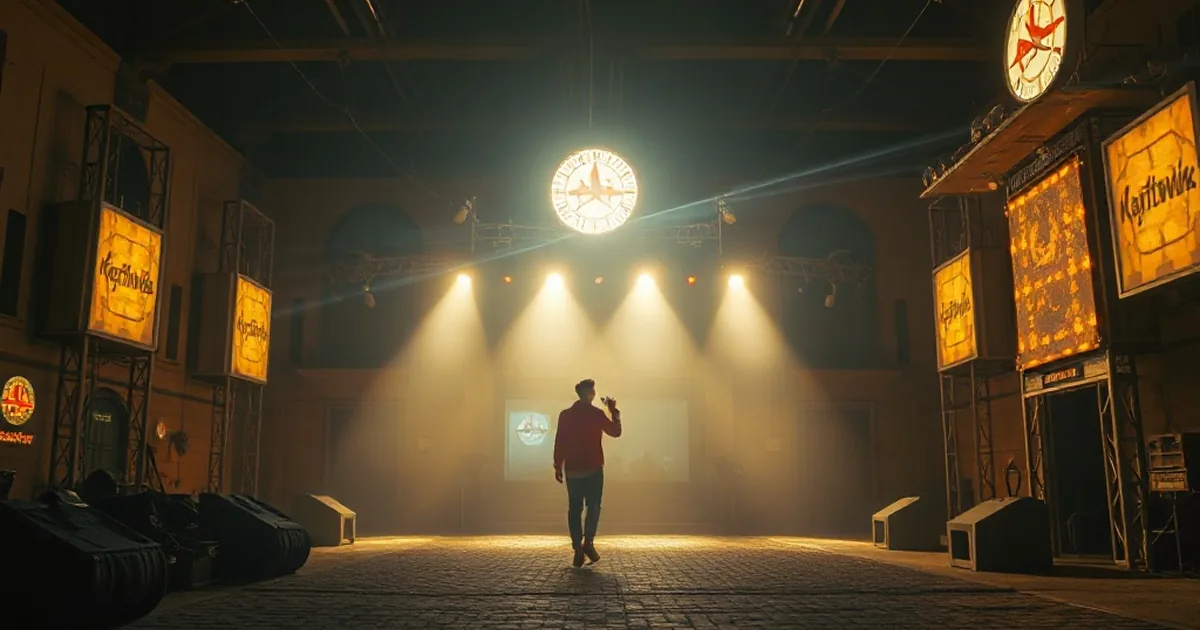
Kraftwerk are not a band you would go to see for stage gestures or guitar solos. Their concert is a carefully considered fusion of sound and image, with four figures standing behind consoles while a world of neon grids, digits, and speeding trains unfolds above them. A live recording compiled from several such performances, 3-D: The Catalogue (2017), won a Grammy Award for Best Dance/Electronic Album.
This is important: for an event like Kraftwerk Prague, never rely on dates and prices from second-hand sources. The date, venue, and entry conditions for a production like this vary by city and by specific tour, and official information comes from the promoter. We continuously track what is coming up in Prague and the surrounding area in our concerts section and in our events calendar. Anyone planning their summer around major open-air programmes should also check out festivals in Prague.
Who exactly is Kraftwerk and why do they matter so much
TL;DR: Kraftwerk are German pioneers of electronic music from Düsseldorf. Without their work from 1974 to 1981, today's club and pop production would sound different.
The beginning was unassuming. Kraftwerk were formed in 1970 in Düsseldorf, where Ralf Hütter and Florian Schneider met while studying at the renowned Robert Schumann Hochschule and shared a passion for experimental music. They were hard to categorise. Under the name Kraftwerk, meaning "power station", they built a stark sound and image within a small but enormously influential circle of German bands that British journalists nicknamed "krautrock", which also included Can, Faust, and Neu!.
The choice of name and language was a statement. At a time when Anglo-Saxon rock dominated the German airwaves, the group from Düsseldorf was searching for its own, purely German voice. They wanted to record in German in order to reaffirm German culture and identity after the war; according to Hütter, their mother tongue, "very mechanical", served as the fundamental structural building block of the music, just like the machines of German industry.
The scale of the mark they left is best summed up by music journalism itself. The New York Times wrote that the press had argued Kraftwerk were the most important musical group since the Beatles, and the less contested claim is that what the Beatles are to rock, Kraftwerk are to electronic dance music. Recognition also came institutionally. In 2014 the band received a Grammy Award for Lifetime Achievement. One of the founders, however, is no longer to be found on stage: Florian Schneider died in 2020.
Autobahn 1974: 23 minutes about a motorway that changed music
TL;DR: The album Autobahn from 1974 made Kraftwerk stars. Almost an entire side of the record is taken up by the title track, which runs for over twenty minutes and was initially passed over in silence by critics at home.
The turning point came with a record nobody expected. Kraftwerk released Autobahn in November 1974, and although its title track is today regarded as the most iconic song in German popular music, it was met largely with indifference at home at the time. While the B-side carried atmospheric instrumentals in the spirit of their earlier experimental albums, the entire A-side was taken up by the gripping title track, which ran for nearly 23 minutes.
The reaction of the domestic press is worth recalling, because it shows how little the critics of the day suspected. The band invited German music journalists for a car ride and played "Autobahn" through the speakers; according to Emil Schult, the general response was a resolute "So what!". But a shortened version broke through. The single first got airplay on a Chicago radio station that had received it as an import, from where it spread across the country and became an international hit.
The numbers speak clearly. In early 1975 the three-minute edit of the title track climbed to number 11 in the UK and number 25 in the US, while the album itself reached number four in the UK, number five in the US and Canada, and number seven in Germany. And technically it was a small miracle. The bass lines on Autobahn were created on a Minimoog driven by an analogue sequencer, three years before Giorgio Moroder used the same approach on "I Feel Love" with Donna Summer.
Robots, mannequins, and Mensch-Maschine: why their show looks different
TL;DR: Kraftwerk rebuilt the idea of what a concert should look like. Instead of rock poses they brought robots, mannequins, and synthesisers, and were decades ahead of their time.
It was not a pose but a carefully considered concept. The band changed ideas about what a "rock" tour should look and sound like when they performed in the United States in the guise of identical mannequins playing exclusively on keyboards, and the title of the album The Man-Machine (1978) captured this idea precisely. It was in 1978 that realistic puppets appeared on stage for the first time as doubles of the band members, and the musicians' live movements were reduced to a minimum. If you see mannequins playing instead of musicians at a concert, it is a deliberate choice that is nearly half a century old.
This aesthetic was forged in one specific building. Kraftwerk's sonic laboratory was the famous Kling Klang studio in Düsseldorf, founded in 1970, an inconspicuous workshop near the railway station where the group painstakingly developed their electronic sound. And although people picture them as cold automatons, it is still live music made by human beings. The drum machines on the album Autobahn were apparently played live rather than programmed, because the tempo fluctuates gently throughout, which is a sure sign of a human player.
From Düsseldorf to Detroit: how techno and hip hop grew out of them
TL;DR: Kraftwerk stand at the origin of Detroit techno, Chicago house, and electro. You hear their influence without knowing it, from clubs through hip hop to contemporary pop.
Their legacy took off in a direction they most likely never anticipated. Kraftwerk became a pioneering influence above all in America, where genres such as Detroit techno and Chicago house clearly drew on their innovative work with electronics. And hip hop? Even its founders value the echo of Düsseldorf within it. Run-D.M.C. co-founder Darryl McDaniels said in an interview with NME that the Düsseldorf group "created" hip hop, not only through the music but also because they built their own machines and computers.
The key to this all-pervasive footprint is robot pop and the vocoder. In the mid-seventies the band moved towards an electronic sound they themselves described as "robot pop". From that grew a list of heirs that reads like an alphabet of modern music. Their "robot pop" inspired everyone from David Bowie to Daft Punk, from Pet Shop Boys to Coldplay. And because they built history step by step, it is worth recalling what it all rests on: commercially successful albums such as Autobahn (1974), Trans-Europe Express (1977), The Man-Machine (1978), and Computer World (1981).
The 3-D show and what to realistically expect at a concert
TL;DR: Current Kraftwerk concerts are built around spatial projection, 3-D glasses, and precise sound. This series gave rise to a museum retrospective and an award-winning recording.
The band honed the current form of the show in galleries and concert halls, not stadiums. In 2012 the Museum of Modern Art in New York presented the retrospective "Kraftwerk - Retrospective 12345678", in which the band performed eight of their studio albums over eight evenings beginning with Autobahn, and the exhibition then travelled to other institutions including Tate Modern in London and became the foundation for a worldwide tour. On 6 February 2013 the group performed the entire album Autobahn at Tate Modern to open their eight-night retrospective.
What does this mean for the audience? Expect a visual experience synchronised with the music, not a big show full of movement. You will be given 3-D glasses and spatial graphics will unfold on the screen while four figures behind consoles remain almost motionless. The repertoire is built on the classic records, so you can expect tracks such as "Autobahn", "The Robots", "Trans-Europe Express", or "The Model". This is an estimate based on setlists from past tours, not a confirmed programme for any specific evening; that you will always find with the promoter of the given event.
If you want to plan a musical summer beyond a single big concert, browse our overview page artists or keep an eye on what is being added in concerts. You will get your bearings quickly and won't miss any dates.
Frequently asked questions
Where and when are Kraftwerk playing in Prague?
Always verify the specific date and venue of a Kraftwerk concert in Prague directly with the promoter and through official ticket sellers, because dates and prices for a production like this vary by tour. You can find a current overview of what is coming up in the capital in our concerts section and in the events calendar.
What is the 3-D show at a Kraftwerk concert?
Audience members receive 3-D glasses and watch a spatial projection synchronised with the music. It was from this series of performances that the live recording 3-D: The Catalogue emerged, which won the Grammy for Best Dance/Electronic Album in 2017.
Do they play live or just play back recordings?
They play live, albeit in a minimalist form with four musicians standing behind consoles. That it is not simply a playback of a recording is also suggested by their earlier work: the drum machines on Autobahn were played live and the tempo fluctuates gently throughout the track, just as it would with a human player.
Why are Kraftwerk so important if I barely know them?
Because they stand at the origin of techno, house, electro, and synthpop, often without the average listener realising it. Their influence is so universal that it has become almost invisible, and virtually every new record carries an echo of their style.
Which album should I listen to first?
Start with Autobahn from 1974. When the band released it, they could barely have imagined that their very German "elektronische Volksmusik" would change the direction of popular music forever. From there you can move on to Trans-Europe Express and Computer World.
Sources
- kdykam.com - concerts in Prague and the surrounding area
- kdykam.com - events calendar
- kdykam.com - festivals in Prague
- kdykam.com - artists
- Wikipedia: Kraftwerk; Autobahn (album); Autobahn (song)
- Britannica - entry on Kraftwerk
- Google Arts & Culture - The Legend of Kraftwerk (Visit Düsseldorf)
- De Gruyter Conversations - How Kraftwerk Invented Electronic Music
- DJ Mag and MusicRadar - context on the album Autobahn and the band's influence