
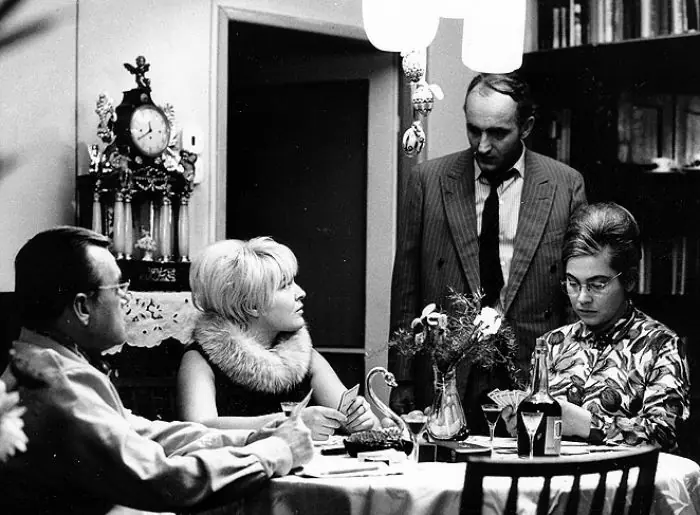
Josef Škvorecký described Vladimír Páral's novella as “a highly experimental work, somewhat influenced by the French nouveau roman but very distinctive. By composing the text from repeated and slightly varied particles - dialogues, character sketches and paragraphs - Páral created an impression of the mechanical monotony of modern life, which slowly but surely deadens everything, including sexual life.”
The film retains this idea but not the experimental style. It aims to be accessible - and, in a good sense, it is. The director lets loose an acting force that never disappointed us and whose absence will be sad.
Jiří Cieslar on Landovský: “It is as if clear, though muted traces of his mayor from Gogol's The Government Inspector at the Drama Club were imprinted on his ‘schizophrenic’ acting, Landovský's most popular theatre role. His mayor also hates the inspector and flatters him at the same time. In swift transitions he plays frozen smiles and servile helpfulness with many bows, sourly mutters strategic instructions to his equally humiliated companions, while barely suppressed fear and anger crush him. A character in a tight spot, who wants to and must not, aggressive and wronged: that is the source of Landovský's shifting comedy, not only its harsh side. So often bound by the dramatic situation, yet essentially unbound: this raw freedom was Landovský's role in the soul of the Drama Club. He never betrayed it. It entered the film only in small traces.”
Films · Prague 178 in the next 30 days →
 90cinemaMon 23.11.The Seventh Seal
 87cinemaWed 25.11.When Marnie Was There
 86cinemaTue 8.12.Rear Window
 83cinemaWed 2.12.Spirited Away
 81cinemaMon 23.11.Obsession
 80cinemaThu 19.11.Cléo from 5 to 7
 80cinemaTue 24.11.Invisible Life
 80cinemaSun 29.11.Vertigo
 77cinemaFri 20.11.The Chorus
 77cinemaFri 20.11.De Gaulle: Résistance
 77cinemaSat 21.11.De Gaulle: Liberté
 77cinemaTue 24.11.Summer of 85