You know that guitar riff from "Breaking the Law" even if you've never touched metal in your life. And here's a fact that might raise an eyebrow: on the Painkiller tour in August 1991, Rob Halford rode onto the stage in Toronto on a large Harley-Davidson, but the stage ramp failed, the singer collided with the half-raised drum riser, broke his nose and briefly lost consciousness, then came back and finished the show. When you type Judas Priest Ostrava into a search engine, you're probably either a fan who wants to see this band live, or a newcomer who heard the name and wants to know what it's all about. This article gives you both: the background of the band and clarity on where to watch for verified dates and tickets, because specific concert dates change and belong in official channels.
Judas Priest Ostrava: why people search for this band
TL;DR: Judas Priest are among the founders of modern metal, which is why everyone searching Judas Priest Ostrava doesn't want to miss a potential show. Verified dates and tickets can be found with the promoter and in our events calendar.
Why the interest? Judas Priest were formed in Birmingham, England in 1969, have sold over 50 million records and regularly appear in rankings of the greatest metal bands in history. They are considered pioneers of the New Wave of British Heavy Metal and a formative influence on a number of subgenres, from speed metal through thrash to power metal. Simply put: without them, the sound of bands from Metallica to Pantera would be different.
And this is no nostalgic full stop on a career. The 2024 album Invincible Shield is their nineteenth studio record and debuted at number two on the UK charts, their highest chart position ever. In early 2026, the band was also recording the foundations of their twentieth album in Nashville. So if you're looking into Judas Priest Ostrava, there's plenty to look into: the band is still touring and creating. Always verify dates and tickets on the official promoter's website and keep an eye on our concerts section so you don't miss a potential stop.
Where they came from: from Birmingham steel to metal gods
TL;DR: The band grew up in industrial Birmingham and after years of struggle broke through in 1980 with the album British Steel. Halford's father worked in the steelworks, so the album title was no coincidence.
Birmingham in the late 1960s was a city of steel, smoke and heavy industry. From this backdrop grew a group that gave heavy music a face and a sound. The beginnings were tough: although they were making pioneering music in the second half of the 1970s, commercial success was slow to come, and the turning point came in 1980 when their sixth studio album British Steel brought them major mainstream attention.
That record came out on 14 April 1980 and changed the rules of the game. Songs like "Breaking the Law" and "Living After Midnight" got radio play and pushed heavy metal into the mainstream. The story behind the album is a human one: Halford's father worked in the steelworks and the singer recalled that the family had just enough for rent and food for the week. The name British Steel was a tribute to their hometown, famous for steel production. And no exaggeration: The Guardian describes British Steel as the album that defines heavy metal.
It was recorded in rather unconventional surroundings. The band rented Ringo Starr's Tittenhurst Park estate, which had previously belonged to John Lennon and Yoko Ono. The album was made quickly and without fuss, which gives it a raw, live energy to this day. Incidentally, this is also the origin of the nickname Halford still carries: their status as one of the definitive and influential metal bands earned them the nickname "Metal Gods" from fans, after their song of the same name.
Rob Halford: voice, leather and a cowboy hat on a Harley
TL;DR: Frontman Rob Halford has a voice ranging from a raspy growl to an operatic falsetto, brought the leather-and-studs look to metal, and in 1998 became the first metal icon to publicly come out as gay.
Halford's voice is a weapon no one else had at the time. AllMusic wrote that in the history of heavy metal there have been few singers with an equally influential and instantly recognisable style, capable of effortlessly moving between a guttural growl and a piercing falsetto. He didn't look to metal for inspiration. As a vocalist he was influenced by Little Richard, Elvis Presley, Janis Joplin and Robert Plant - people who treated the voice as an emotion. That's why his screams still sound musical after decades, not just abrasive.
The second thing Priest permanently wrote into metal is the visual. The image of leather, studs and other taboo items of clothing was highly influential in the glam metal era of the 1980s. The leather gear was quickly adopted by fans and became more or less the official uniform of the genre. To that belongs the legendary ride onto the stage. Halford has for years ridden onto the stage on a Harley-Davidson at the opening of "Hell Bent for Leather". How did it actually come about? When the band was touring England, they thought it would be cool to bring a motorbike on stage for that song, so in each city they asked the crew if they could find some bikers who would lend them a bike in exchange for a few T-shirts or a drink.
And thirdly, courage beyond music. Halford publicly came out as gay on MTV in 1998. He was one of the first metal musicians to come out, and at the time by far the most famous. Interesting is how it happened: according to Halford himself, it was not planned at all. In the macho world of 1980s metal it was a bold step, but fans accepted it and Halford became a symbol of openness in a fairly conservative world.
Twin guitars and albums you need to know
TL;DR: The Priest trademark is the so-called twin-guitar attack, the harmonised interplay of two guitars. To get started, three albums are enough: British Steel, Painkiller and the current Invincible Shield.
The band's sonic signature isn't just Halford. His falsetto style and the twin-guitar sound of Downing and Tipton are among the key influences on heavy metal as a whole. Fans say Priest practically invented that twin-guitar attack: harmonised solos and galloping riffs where two guitars interweave into one melody later became standard equipment for the genre.
If you want to hear what we're talking about, there are three sure bets. British Steel (1980) is tight, full of hits and accessible. Painkiller from 1990 is a sharp and brutal record, and this is also where a key face of the current band appears: drummer Scott Travis joined in 1990, replacing Dave Holland. And thirdly the recent Invincible Shield, which proved the band still has teeth: with this 2024 album, Judas Priest became the first metal act to release studio albums fifty years apart.
The lineup has changed a great deal over more than half a century. K. K. Downing left in 2011 and was replaced by Richie Faulkner. Glenn Tipton reduced his touring from 2018 due to Parkinson's disease and is represented on stage by Andy Sneap. The current recording lineup consists of Rob Halford, bassist Ian Hill, guitarists Faulkner and Sneap, and drummer Scott Travis. Recognition has also come from above: in 2010 they won a Grammy for Best Metal Performance and in 2022 they were inducted into the Rock and Roll Hall of Fame.
What a Judas Priest concert looks like and what to expect
TL;DR: The show is built on big sound, leather styling and Halford's motorbike entrance. The setlist mixes evergreens with newer material from Invincible Shield.
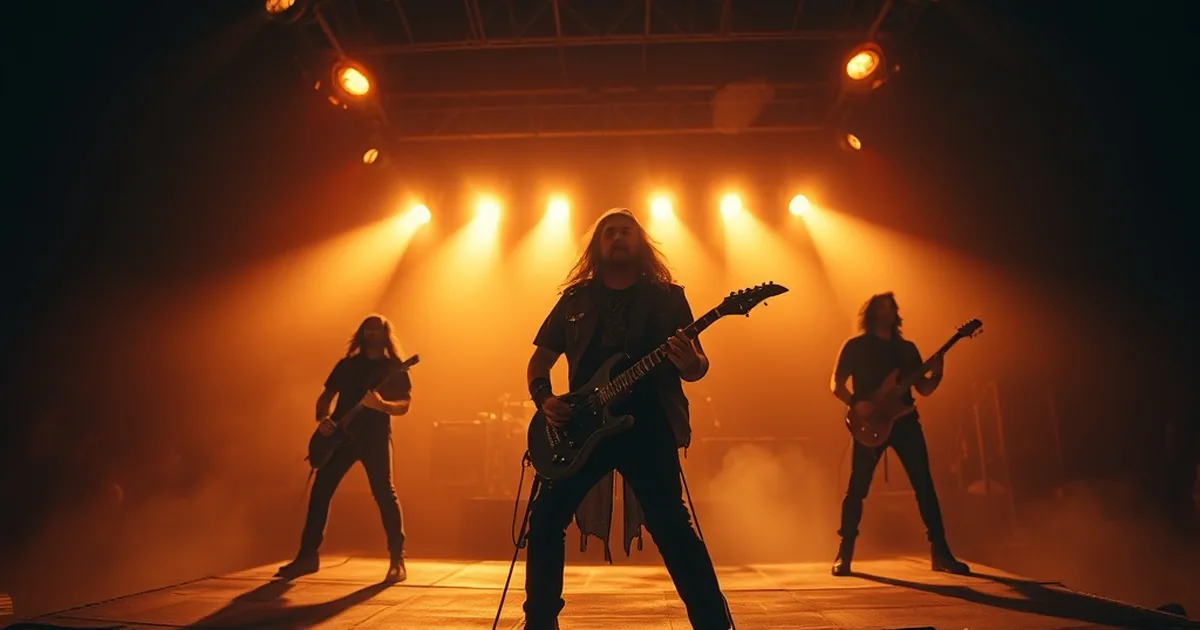
Anyone who has seen Judas Priest knows it's not a jukebox of old hits. Halford stands behind the leather-biker look of metal and Priest concerts are still spectacular affairs, with the frontman riding a Harley-Davidson across the stage. But you also get fresh material. Invincible Shield was created under pandemic conditions remotely, between Nashville, Phoenix and European cities, and Faulkner promised the songs would be more progressive in places.
As for the repertoire, any Priest fan knows that certain songs almost never drop from the setlist. "Breaking the Law", "Living After Midnight" and "Metal Gods" have been pillars of their live show since the 1980s. Add Halford's falsettos, twin guitars and the leather visual style the band still bets on. And of course the motorbike for "Hell Bent for Leather", which went from a one-off idea to a permanent fixture of their show.
One thing to be clear about: the phrase Judas Priest Ostrava does not automatically mean a confirmed concert with a fixed date and venue. Major tour dates are announced and changed, tickets are sold through official promoter channels and often sell out within minutes. So leave date verification to official sources and keep an eye on our concerts section and events calendar, where any stop will appear as soon as it is confirmed.
Before you go: how to watch for dates and what to do in Ostrava
TL;DR: Buy tickets only from the official promoter to avoid overpriced second-hand offers. And if you're spending the whole day in Ostrava, the city has more culture to offer.
A few practical rules so you don't get burned. Buy tickets for major concerts exclusively through verified sales channels of the promoter - overpriced second-hand tickets aren't worth it and often don't even work. Check the date and venue on the official website, not based on vague social media posts. And for arena events it's generally worth arriving with time to spare to avoid queues at the entrance.
If you're heading to Ostrava for a full day or weekend, the city doesn't live by just one evening. Those who enjoy theatre might come across an adaptation of The Picture of Dorian Gray at Divadlo Petra Bezruče, a story by writer Oscar Wilde. A more serious musical treat is provided at Kampus Palace by the programme Nová nauka o harmonii + V očích vážky, revisiting the legacy of Czech composer Alois Hába. A complete overview of venues can be found in the theatre section and a list of artists in the artists section.
Frequently asked questions
Are Judas Priest playing in Ostrava?
We don't confirm specific confirmed dates here, because major tour dates are announced and changed and belong in official channels. What is certain is that the band is still actively touring and recording, so it makes sense to follow the official promoter's website and our events calendar, where any stop will appear as soon as it is confirmed.
Who is in Judas Priest today?
The constants are vocalist Rob Halford and bassist Ian Hill. On guitars are Richie Faulkner and Andy Sneap, and Scott Travis sits behind the drums. Glenn Tipton remains a member of the band, but due to Parkinson's disease has reduced his touring since 2018, which is why Sneap represents him on stage.
Why are they called Metal Gods?
The nickname "Metal Gods" came from the song "Metal Gods" on the British Steel album and was given to the band and to Halford by fans because of their status among the founders of the genre. Halford also registered it as a trademark for his company.
Which albums should a newcomer listen to?
Start with British Steel from 1980 - it's full of hits and accessible. Then try Painkiller from 1990 to hear their hardest side. And finally the current Invincible Shield from 2024, so you're clear that the band is far from fading out.
Is the concert worth it even for a newcomer who doesn't listen to much metal?
Absolutely. Hits like "Breaking the Law" or "Living After Midnight" are known even to people outside the genre, and an arena show with a motorbike on stage works as a great spectacle even for the uninitiated. If you want to come prepared, listen to British Steel and Painkiller beforehand.
Sources
- Judas Priest - Wikipedia (origins, influences, awards, nickname)
- Rob Halford - Wikipedia (voice, Harley in Toronto, coming out)
- Invincible Shield - Wikipedia (nineteenth album, chart positions)
- Ultimate Classic Rock: British Steel (release date, context of 1980)
- Last.fm: Judas Priest (lineup, discography)
- Ultimate Classic Rock: Halford coming out (MTV 1998)
- Events from the kdykam calendar: The Picture of Dorian Gray, Nová nauka o harmonii + V očích vážky