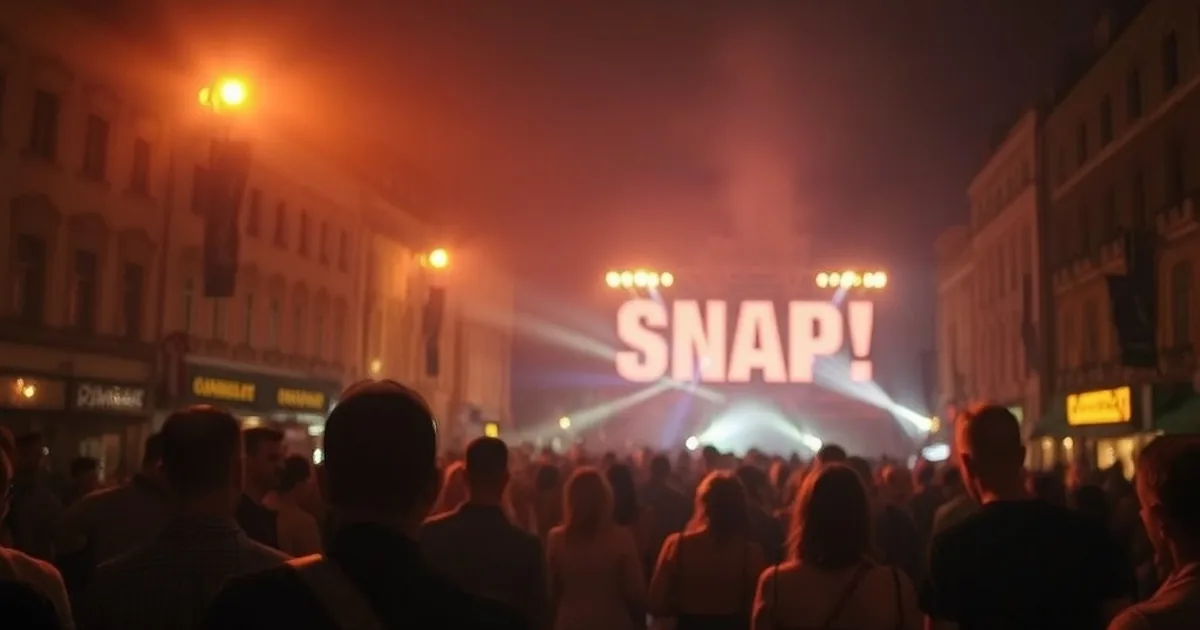
You know that chorus even if someone woke you up at three in the morning: "Rhythm is a dancer". And right away a fact that will make you raise an eyebrow - one of the biggest dance hits of the nineties almost never came out. Turbo B, the group's own rapper, actually objected to its release and preferred the track "Colour of Love". We're talking about Snap!, the German eurodance crew, and if you're writing Snap! Brno in your diary, here's who you're actually going to see.
Behind the Snap! name there isn't one face, but a rotating cast of producers and singers and a few stories spicier than the hits themselves. Like the fact that the famous synth riff everyone recognises after just a few notes is actually an old recording. Producers Anzilotti and Münzing used an older electro sample as the driving engine of "Rhythm Is a Dancer", slowing it down to a speed at which it's practically unrecognisable.
Snap! Brno: why you should see this eurodance icon live
Snap! Brno is a chance for newcomers to hear live the songs that shaped the sound of the nineties, and for those who remember them a reminder of how tangled a history lies behind those choruses.
Snap! don't belong in the "one hit and done" box. Among their best-known songs are "The Power" from 1990 and "Rhythm Is a Dancer" from 1992, both of which reached number one in multiple countries. Those are two separate pan-European smashes, not a coincidence. So if Snap! come to Brno, it won't be a nostalgic trip down memory lane for one song, but a band that was there at the birth of the entire dance pop of the nineties. Always check the exact date, venue and ticket link with the official promoter and in our events calendar - from there you'll go straight to the event page, not to scraps from social media. And once the Snap! Brno event is confirmed, you'll find it there with all the practical details.
Who Snap! actually are and where they came from
Snap! is a German eurodance project from Frankfurt, built around two producers hiding behind made-up names and a whole series of rotating singers and rappers.
Snap! is a German eurodance, hip-hop and pop project founded in 1989 by Frankfurt producers Michael Münzing and Luca Anzilotti. The pair had already been active in music before that. Luca Anzilotti and Michael Münzing began working together in 1985 in the group Off, alongside Sven Väth. So 1985 marks the start of their partnership, while Snap! itself didn't come together until four years later.
A rotating lineup at the microphone is typical of the group. Over the years the lineup has included a number of American singers, songwriters and rappers, among them Thea Austin, Turbo B, Niki Haris and Penny Ford. The band was essentially a production workshop and voices came and went as needed.
And here's one small detail that says a lot about the era. Münzing and Anzilotti adopted the stage names Benito Benites and John "Virgo" Garrett III because they wanted to distance themselves from established ideas about German music. Frankfurt was no backwater, either. It was from here that the European dance sound spread in the nineties, and Snap! were its flagship.
The Power: the accidental launch of an entire genre
The debut "The Power" was assembled from samples of other people's recordings, had to be re-recorded for America because of uncleared rights, and still became a worldwide hit.
The original version was released on 3 January 1990 through Logic Records in Germany and contains samples from "Let the Words Flow" by Chill Rob G, "Love's Gonna Get You" by Jocelyn Brown and "King of the Beats" by Mantronix. The famous chorus "I've got the power" has its own story too. The song grew out of a demo session in 1989 where singer Penny Ford, recommended by Chaka Khan, spontaneously sang that iconic line.
The catch was copyright. The samples were uncleared, so for the American release the recording had to go through a transformation. Turbo B, real name Durron Butler, whom the producers recruited from a US military base in Germany, re-recorded the parts originally sampled from Chill Rob G. Getting a rapper essentially recruited from the military as the starting point for a career that ended in worldwide fame is quite an unusual beginning.
The song broke through immediately. "The Power" reached number one in Greece, Luxembourg, the Netherlands, Spain, Switzerland, the United Kingdom and Zimbabwe, as well as on the American Dance Club Play and Hot Rap Singles charts. On the main American chart it was a fraction tighter. On the Billboard Hot 100 the track climbed to number two, behind "Vision of Love" by Mariah Carey. That it was no flash in the pan was confirmed by later recognition. In 2022 Rolling Stone magazine included "The Power" in its list of "The 200 Greatest Dance Songs of All Time".
Rhythm Is a Dancer: the hit that almost ended up in a drawer
The band's biggest song was originally meant to be shelved, was built from a cleverly recycled sample, and its own rapper fought against it - yet it still became one of the best-selling singles of the year.
"Rhythm Is a Dancer" was released in March 1992 on Arista and Logic Records as the second single from the second studio album The Madman's Return and features the vocals of American singer Thea Austin. The road to fame wasn't straightforward, though. The track was originally meant to be the lead single from the second album, but it was pushed back and "Colour of Love" came out instead.
Behind that lay resistance from within the band. Thea Austin came to the project by a roundabout route. She was brought into Snap! by original singer Penny Ford, who had already left for a solo career but was still involved in writing, and Austin, who was working at the time as a music journalist and songwriter, was sent to the producers in Germany.
The sound everyone remembers is the result of clever recycling. "Rhythm Is a Dancer" samples the song "Automan" by American electro-hip-hop group Newcleus from 1984. The track is written in A minor at a tempo of 124 beats per minute. The famous line about cancer that Turbo B raps in the chorus is one of the most discussed lines of the entire era. That controversial verse compares the seriousness of the message to the relentlessness of cancer to emphasise that rhythm is a life-defining force, not just a catchy phrase.
When the single finally came out, the numbers spoke for themselves. The track became Snap!'s biggest hit to that point, reaching number one in Germany, the United Kingdom, France, Switzerland, Austria, the Netherlands and Belgium. In the US it climbed to number five on the Billboard Hot 100. In the UK it was particularly strong. It was the second best-selling single of 1992, right behind "I Will Always Love You" by Whitney Houston. It spent six weeks at number one on the UK chart and sold 583,000 copies. German magazine Bunte then coined a nickname for the track that stuck: it called it "the mother of all eurodance songs".
The song has its human side too. Thea Austin, whose vocals open the whole track, says she feels blessed to have been part of it, and that she still hears the song in lifts, at aerobics classes, in salons and in shops. And one more backdrop you might remember from the video. The music video was directed by British director Howard Greenhalgh and was filmed at the Kennedy Space Center in Florida, where Turbo B plays bass guitar in a smoke-filled garden of rockets. It was the last video to feature both Turbo B and Austin before they left the group.
How Snap! influenced the nineties
Snap! weren't just two catchy songs - they were the trigger for a wave that spread eurodance across Europe, and their mark can still be heard in pop today.
The band didn't stop at two smashes. "Ooops Up", a cover of the Gap Band song, reached number two in Germany and number five in the UK. That was followed by the Middle Eastern-flavoured "Cult of Snap" (number three in Germany, number eight in the UK) and "Mary Had a Little Boy" (number four in Germany, number eight in the UK again). The debut album was no flop either. World Power sold over seven million copies worldwide, reached number ten in the UK where it went platinum, and number thirty in the US. Across their career the band put together an impressive tally. Snap! sold over 15 million records and helped shape the sound of an entire generation.
You can hear the influence of this crew in younger music too. The single "Of the Night" by British indie-pop band Bastille from 2013 is a mashup of "Rhythm Is a Dancer" and another dance classic, "The Rhythm of the Night" by Corona. The song "Don't Tell 'Em" by American singer Jeremih and rapper YG from 2014 then directly interpolates the melody. The classic lineup era ended in the mid-nineties. In 1996 the group officially disbanded after releasing the compilation Snap! Attack: The Best of Snap!, which also included new versions of their two biggest hits, "The Power '96" and "Rhythm Is a Dancer '96". If you enjoy browsing who from that era is playing near you, check out the overview in the artists section and compare the names you remember from the radio.
What to expect from a Snap! live show
A Snap! live set is built around big sing-along choruses; always check the date, venue and tickets in our calendar and with official sellers, not from hearsay.
A band with this repertoire still tours major stages, tours and retro events. Snap! continue to perform on global stages, arena tours and nostalgic dance nights with an energetic set that has the audience singing and jumping. They already proved their songs work in front of a huge crowd. On 27 June 2010 Snap! performed at Glastonbury Festival with original singer Penny Ford and rapper Benjamin Lowe. So expect classics like "The Power" and "Rhythm Is a Dancer" on the dancefloor, and an evening geared more towards dancing than quiet listening.
And now the practical part, honestly: don't take the specific date, venue address or ticket price from the first link you come across. Check them with the official promoter and verified sellers. Confirmed information about any upcoming event can be found in the concerts section and in the overall events calendar, where you'll go straight to the event page with the date, venue and ticket link. If you're buying a ticket second-hand, only use a seller who guarantees authenticity.
Frequently asked questions
Is Snap! a British band?
No, that's a common mistake. Snap! is a German eurodance project founded in 1989 by Frankfurt producers Michael Münzing and Luca Anzilotti. The singers and rappers were mostly American, but the project itself was created in Germany.
Who sings "Rhythm Is a Dancer"?
The main female vocal belongs to American singer Thea Austin. The track features her vocals, and it's her voice that opens the whole song. She was brought into the band by previous singer Penny Ford.
Why did the producers use fake names?
It was a marketing defence. Münzing and Anzilotti adopted the names Benito Benites and John "Virgo" Garrett III because they wanted to distance themselves from established ideas about German music. They wanted to come across as international rather than German.
Where does the famous riff from "Rhythm Is a Dancer" come from?
From a pretty old recording. The track samples the song "Automan" by Newcleus from 1984. The producers slowed the original synthesiser sample down to a speed at which it's practically unrecognisable.
Where can I find out if Snap! are playing in Brno?
Always check the date, venue and ticket link with the official promoter and in our calendar. Keep an eye on the concerts and events calendar sections, where a confirmed event will appear with all the practical details. Don't rely on dates circulating on social media.
Sources
- Wikipedia: Snap! (group profile, members, discography, 1996 disbandment)
- Wikipedia: The Power (Snap! song) - origins, samples, chart positions
- Wikipedia: Rhythm Is a Dancer - release, Newcleus sample, key and tempo, video
- Last.fm: Snap! biography - founding, pseudonyms, lineup
- Grokipedia: The Power / Rhythm Is a Dancer - background, Penny Ford and Chaka Khan, sales
- Micro-Chop (Medium) - sample breakdown and behind the scenes of "Rhythm Is a Dancer", Thea Austin quotes
- SongSense, WhoSampled - samples and release circumstances
- kdykam.com: events calendar, concerts and artists