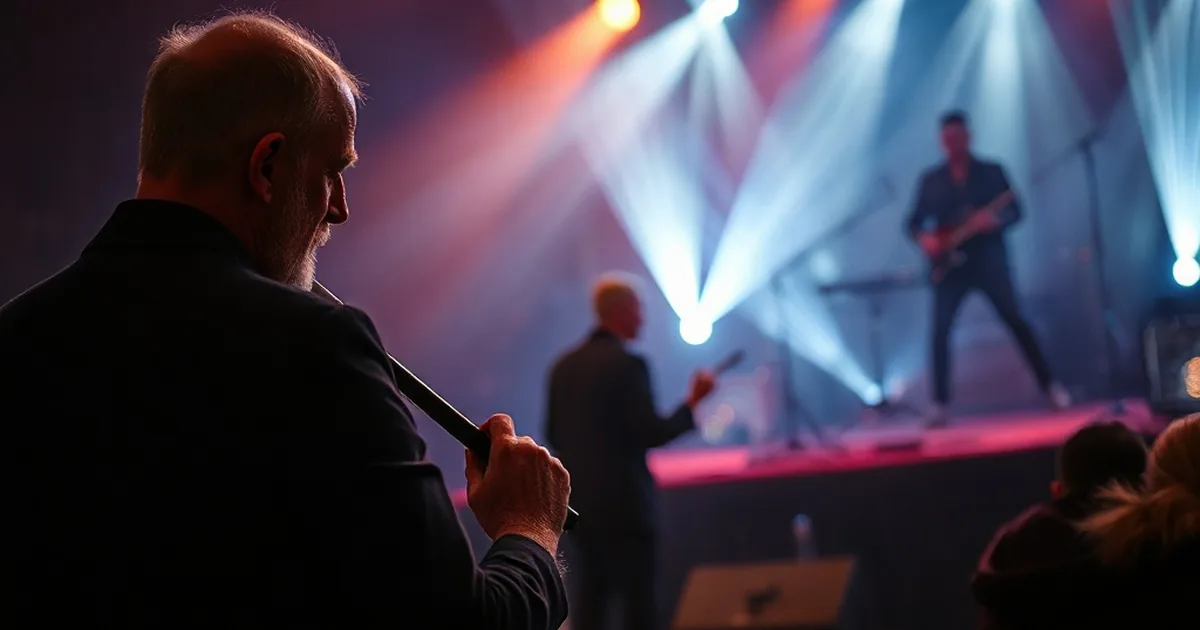
You know that feeling from an out-of-tune piano in a hallway, or from a folk song where the singer slides somewhere between the notes? It doesn't sound bad, just different, and your ear sharpens. That is exactly where Miroslav Beinhauer concerts live - today the only place where you can hear the sound of Haba's sixth-tone harmonium live. And here is one thing that will raise your eyebrow: the instrument he plays spends most of the year in a display case at the Czech Museum of Music in Prague, and its purchase was once supported by President Masaryk himself with a contribution of ten thousand crowns. The first Czechoslovak president Masaryk supported the purchase of the instrument with a contribution of ten thousand crowns, and the same amount was contributed by the then Ministry of Education and National Enlightenment.
Whether you are a newcomer drawn by a musical rarity or a contemporary music listener looking for a fresh angle, this text will guide you. We will look at who Beinhauer is, why his sound has no equivalent in ordinary concert life and how to keep track of dates and tickets.
Miroslav Beinhauer concerts: why go to a player you will hear nowhere else
In short: Beinhauer is a Czech pianist born in 1993 who focuses on contemporary music and the repertoire of the 20th century, and is most likely the only person in the world who masters the sixth-tone harmonium today.
As a pianist and player of the sixth-tone harmonium, Miroslav Beinhauer (*1993) focuses on contemporary music and the music of the 20th century. That is the core of why Miroslav Beinhauer concerts stand apart from the usual piano recital: you are not in for an evening built from Chopin and Liszt, but mainly music by living composers and things you will not find on any other programme. The sound on which it all rests can do both. According to Beinhauer, this music is for everyone, because microtones offer a wealth of possibilities; it can sound like it comes from a completely different world, even crazy, but also very beautiful - in fact more beautiful than the standard semitone system.
Beinhauer is a native of Ostrava, to which he still has a strong connection. He grew up in Ostrava and dedicates himself to the music of the 20th and 21st centuries. He was drawn to the keyboard from the earliest age. According to his parents he started playing the piano at the age of three, immediately attended the Vilem Petrzelka Elementary Art School in Ostrava-Hrabuvka and then the music gymnasium at the Janacek Conservatory. He then gathered his education at prestigious addresses. He studied at the Janacek Academy of Music and Performing Arts in Brno under Helena Weiser, then at the Universitat fur Musik und darstellende Kunst in Vienna under Jan Jirack von Arnim and at the Royal Conservatory in Ghent under Daan Vandewalle. If you want to browse more names from the contemporary and classical scene, the overview of artists is a good place to start, where you will find musician profiles along with their upcoming dates.
The instrument mastered by only one person in the world today
In short: the sixth-tone harmonium is a world-unique instrument from the workshop of Alois Haba. Instead of the usual division of a tone into two semitones, it divides each tone into six parts, and Beinhauer is its only concert player.
Most music we know is built on twelve semitones in an octave. Haba went further. The sixth-tone harmonium looks essentially like an ordinary pedal harmonium, but what makes it exceptional is the key system: each tone is not divided into two halves as in a regular harmonium, but into six sixths. In practice this means that a semitone breaks down into thirds. The semitone here is not divided into halves as in the quarter-tone system, but into thirds, so the instrument can play sixth-tones and third-tones, but not quarter-tones.
To fit all of this under the hands, the instrument had to be given an entirely new keyboard logic. Because there are three times as many tones and keys in each octave as on a standard keyboard instrument, a system had to be devised that could accommodate all the extra keys while still making the instrument playable at all. The result is a keyboard unlike any other. The result is a complicated system that, in addition to black and white keys, also has blue keys and resembles nothing Beinhauer had ever seen.
The instrument also has its own pedigree and address. The first model of the sixth-tone harmonium was built in the 1920s on commission from the pioneer of microtonal music Alois Haba, whose vision convinced the firm August Forster; an improved model dates from 1936 by the same firm. Today there is practically only one playable example. The only functional specimen of the sixth-tone harmonium in the world belongs to the collections of the National Museum and is permanently on display at the Czech Museum of Music in Prague. That is exactly where Beinhauer goes to practise. The only publicly accessible specimen in the world is located at the Czech Museum of Music in Prague as part of the permanent exhibition of musical instruments.
How a pianist became the world's only specialist
In short: Beinhauer came to the harmonium in 2018 during the premiere of Haba's opera in Ostrava, when the original player dropped out a few weeks before the premiere. The instrument captivated him so completely that he moved to Prague because of it.
The story begins far more dramatically than one might expect. In 2018 the festival New Opera Days Ostrava was preparing the world premiere of Haba's sixth-tone opera Thy Kingdom Come, written nearly a hundred years earlier; a few weeks before the premiere the harmonium player cancelled and the production had to find someone who could learn the instrument as quickly as possible and grasp its system - Beinhauer tried, and it gripped him so completely that he stayed with the sixth-tone harmonium. At that point he was still a pure pianist. The instrument was woken from its deep sleep at the Czech Museum of Music in 2018 by the then twenty-five-year-old, until then solely a pianist, Miroslav Beinhauer, who took up the festival organisers' request to play the part in the opera Thy Kingdom Come.
It could have ended there, but it did not remain a one-off favour. Beinhauer was so fascinated by the possibilities of the instrument that he moved to Prague just so he could practise on it at the National Museum. The first major undertaking was a recording of an archival work. In 2018 he took part in the premiere of Haba's sixth-tone opera, which was followed by the study and recording of Haba's opus Six Pieces for Sixth-Tone Harmonium op. 37, which for over ninety years had been the only solo composition for this instrument. The piece was composed in 1928 and Beinhauer recorded it for the first time in 2019 in Prague. That a return to the stage is not taken for granted is illustrated by a small backstage detail: to get from the instrument what he needed, ordinary clothes pegs came into play, as he later admitted.
What you will hear at the concert: from Haba to living composers
In short: the programme is built on music of the 20th and 21st centuries. The backbone is the work of Alois Haba, joined by pieces written specifically for Beinhauer and for this one-of-a-kind instrument.
Beinhauer did not stay with the archive. Instead of touring festivals with a single historical piece as a curiosity, he set about finding the instrument a new life. Since then at least twenty new compositions have been written for the instrument, not only solo pieces but also chamber works and pieces for harmonium with chamber orchestra accompaniment. A number of prominent names in contemporary music responded to his call. Thanks to collaboration with several ensembles and festivals, new pieces for the instrument were written by composers such as Phill Niblock, Bernhard Lang, Georg Friedrich Haas, Klaus Lang, Marc Sabat, Gerard Pape and Arash Yazdani.
The fruits of this work can also be listened to at home. The double album Pieces for Sixth-Tone Harmonium brings works by Alois Haba, Klaus Lang, Milan Gustar, Ian Mikyska, Judith Berkson, Idin Samimi Mofakham, Bernhard Lang and Phill Niblock performed by Miroslav Beinhauer. Those same pieces were heard live first. The premiere of these compositions took place in August 2023 as part of the contemporary music festival Ostrava Days. That concert had its own atmosphere. In the first part of the evening Miroslav Beinhauer performed seven new compositions on the sixth-tone harmonium; it was he who set the colossus from the Czech Museum of Music collection resonating, recently awakened after a century of sleep.
Alongside microtonal rarities, Beinhauer also has a large solo literature for the classical piano at his disposal, which gives a sense of his range. As a soloist he has performed Magnus Lindberg's Second Piano Concerto, John Adams's piano concerto "Must the Devil Have All the Good Tunes?" and Esa-Pekka Salonen's piano concerto. Those looking for a more classical concert experience or a chamber evening can browse our overview of concerts and filter by city and date.
Career, orchestras and recordings
In short: Beinhauer is a sought-after chamber musician and studio artist. He has recorded the complete piano works of Haba, released albums for sixth-tone harmonium and regularly records for radio.
As a chamber musician he has a solid home base. He is a sought-after chamber musician and a member of the international ensemble Ostravska Banda, where he has collaborated with conductors such as Bruno Ferrandis, Johannes Kalitzke, Petr Kotik, Jiri Rozen and Owen Underhill. He can also be heard beyond concert halls. Beinhauer also regularly records for Czech Radio. His concert record is by no means modest. He has dozens of concerts to his name and is the only instrumentalist in the world capable of playing the unique sixth-tone harmonium built for Alois Haba.
Recent years have been devoted to major projects. He recorded the complete piano works of Alois Haba, released by Supraphon in 2025. And he has not stopped releasing. In the first months of 2026 he came out with two new ventures: the book Alois Haba - Keyboard Works and the album Pieces for Broken Piano. That a museum exhibit has truly become a living instrument is also thanks to the people around him. Prague Quiet Music Collective brought this rare instrument from the National Museum collection into the sphere of living art and proved that even museum exhibits can be made into a living part of musical culture.
Where to find dates and how to buy tickets
In short: we do not yet have Beinhauer's own dates in our calendar. His concerts tend to appear sporadically at contemporary music festivals, so it is worth following the official channels of the artist and the organisers.
Let's be honest: we cannot promise you a specific date for a Beinhauer recital right now, because his performances are not a stadium tour but intimate events tied to a particular venue or festival. At least you know where to look. His concerts regularly appear at Prague's MicroFest at the end of April and at Ostrava Days at the end of August. He also returns to his home region outside the festival calendar. He still has a strong personal and professional connection to Ostrava, recently recorded there for the radio and travels to the region for Christmas concerts.
In practice this means keeping an eye on the artist's official website, the pages of the organising festivals and the standard ticketing systems where tickets usually appear under his name. Because both the instrument and the performer are unique in their own right, the capacity of chamber halls tends to be limited, so waiting until the last minute does not pay off. You can find the ongoing programme of live music across the Czech Republic in our events calendar, where dates are added on a rolling basis.
Before a Beinhauer date appears, you might be drawn to a related chamber evening in an unconventional space, where an intimate hall and a programme the listener has to discover for themselves play a key role. In this family you will find, for example, the music-literary evening Miroslav Zikmund: Poeticky romantik at the Museum and Gallery of Northern Pilsen Region in Marianska Tynice (22 September 2026) or the composed evening Na zamku s Miroslavem Taborskym at Kozel State Chateau (14 August 2026). These are not Miroslav Beinhauer concerts, but they follow a similar logic: a smaller space, a focused audience and a programme outside the mainstream.
Frequently asked questions
Who is Miroslav Beinhauer?
He is a Czech pianist and player of the sixth-tone harmonium, born in 1993. Miroslav Beinhauer is most likely the only person in the world who masters Alois Haba's sixth-tone harmonium. Alongside microtonal music he also has standard piano literature of the 20th and 21st centuries in his repertoire.
What exactly is the sixth-tone harmonium?
It is an instrument from the workshop of Alois Haba that, instead of the usual division of a tone into semitones, divides each tone into six parts. In 1927 the first sixth-tone harmonium was built, and in 1928 Haba wrote Six Pieces for Sixth-Tone Harmonium op. 37 for it. Outwardly it looks like an ordinary pedal harmonium; what makes it exceptional is the key system.
Where can I buy tickets for Miroslav Beinhauer concerts?
Tickets appear with the organising festivals and in standard ticketing systems under the artist's name, or on his official website. Because these are chamber events with limited capacity, we recommend monitoring sales in advance and also keeping an eye on our events calendar, where live music dates are added on a rolling basis.
Do I need to understand contemporary music to enjoy the concert?
Not at all. The magic lies precisely in hearing a sound you know from nowhere else. According to Beinhauer himself, this music is for everyone: it can sound unusual and wild, but also surprisingly beautiful. Many of these evenings also include a short introduction or a discussion with the performer, so you will find your way into the unfamiliar intervals more easily than you expect.
Does he only perform in Prague?
No. Although the instrument has its home exhibition in Prague, Beinhauer performs throughout the Czech Republic and abroad. He regularly returns to his native Ostrava, where he plays Christmas concerts among other things.
Sources
- Radio Prague International: interview about the revival of the sixth-tone harmonium (english.radio.cz)
- KlasikaPlus.cz: interview about the sixth-tone harmonium and its system
- Vltava (Czech Radio): article about the premieres of recordings for sixth-tone harmonium
- Ostravan.cz: report from the concert at Ostrava Days 2023
- Sub Rosa / Discogs: data on the double album Pieces for Sixth-Tone Harmonium
- Supraphon.com: information about the recording of the complete piano works of Alois Haba
- HISvoice.cz: review of the book Alois Haba - Keyboard Works and the album Pieces for Broken Piano
- Magazin Nase mesto: interview with Miroslav Beinhauer about Ostrava and the instrument
- Prague Quiet Music Collective (pqmc.cz): information about the instrument and its return to the stage
- kdykam.com: Miroslav Zikmund: Poeticky romantik, Na zamku s Miroslavem Taborskym, overview of concerts and artists