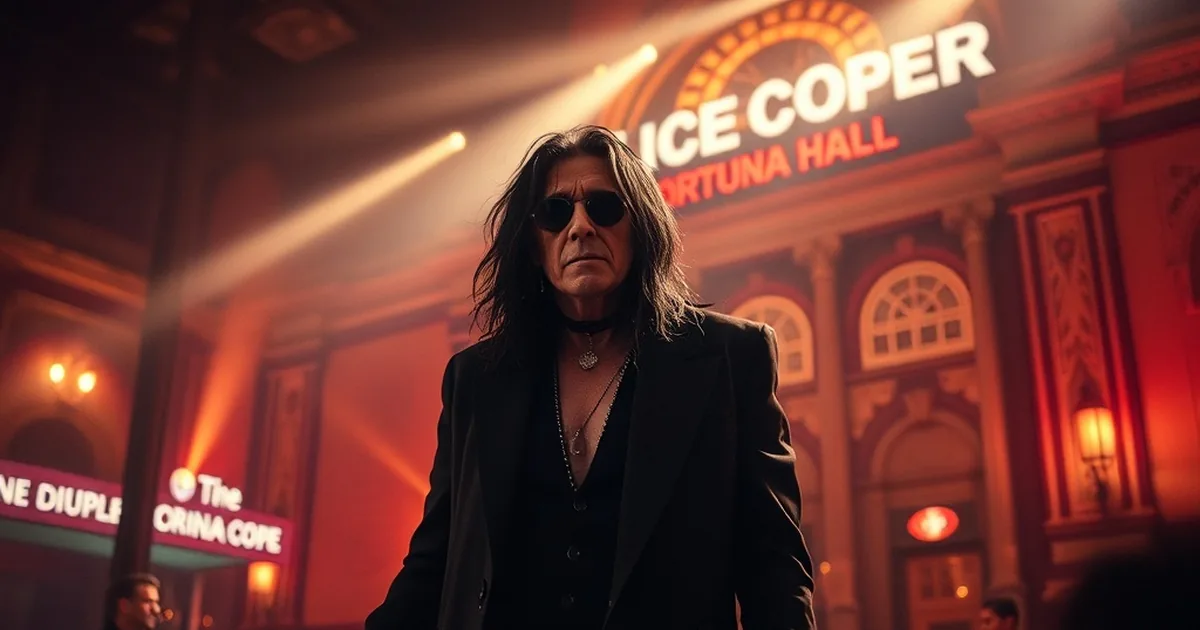
The name Vincent Damon Furnier probably means nothing to you. But that raspy shout of "School's Out" at the start of summer break, a guillotine on stage and smeared eyeliner like after a nightmare? That's him. And here's one thing few people know: his most famous "shocking" moment was never planned at all. In 1969, a chicken got onto the stage in Toronto and Furnier, convinced the bird could fly, threw it back into the crowd - but instead of flying away, it fell into the front rows and the audience tore it apart. The next day the papers wrote something else entirely. When you type Alice Cooper Prague into a search engine today, this is the legend you're looking for - the man who turned one misunderstood incident into an entire musical genre.
Alice Cooper Prague: what to know about this legend before you see him live
Behind the name Alice Cooper Prague is an American rock icon nicknamed the godfather of shock rock. Even approaching eighty, he tours the world, so this is a very much alive artist, not a museum exhibit.
Many people picture Alice Cooper as an old man in a mask coasting on past glory. The reality is different. Cooper was born on 4 February 1948, making him over seventy, yet according to the British Planet Rock he regularly plays over a hundred concerts a year and claims to be in better shape than he was at twenty. He also appears at major festivals like Hellfest, Copenhell and Graspop Metal Meeting and collaborates with younger artists. A specific Prague date has not yet been confirmed, but if you want to know who Alice Cooper actually is and why his name belongs in the same sentence as Kiss or Marilyn Manson, read on. When the Alice Cooper Prague poster appears, you'll know what you're getting into.
Who hides behind the mask
Alice Cooper was originally not a person but a band. Vincent Furnier, the son of a preacher, crafted the stage persona so thoroughly that he eventually had the name legally registered as his own.
Alice Cooper, born Vincent Damon Furnier, is an American singer and songwriter whose career spans six decades and who is considered the "godfather of shock rock" by music journalists and peers alike. He drew from horror films, vaudeville and garage rock to create a morbid, theatrical strain of rock designed to shock its audience. Interestingly, Alice Cooper was not a frontman at the start but an entire group. The band formed in 1964 in Phoenix, Arizona, and consisted of Furnier, guitarists Glen Buxton and Michael Bruce, bassist Dennis Dunaway and drummer Neal Smith.
Before they became Alice Cooper, they went through two names and one humiliation. As high schoolers they called themselves the Earwigs, put on wigs and costumes for a school talent show to look like the Beatles, and their set consisted of Beatles parodies they weren't even really playing. They still won first prize. That win pushed them to form a real band. The name Alice Cooper also comes with a story worthy of a good screenplay. According to one account, the name came from a witch who supposedly spoke to Cooper through a ouija board, and Furnier himself wrote in his book Golf Monster that the name conjured the image of a little girl with a lollipop in one hand and a butcher knife in the other.
The Alice persona was a calculated move. Cooper noticed that the rock scene was full of idols and heroes but had no proper villain, and he decided to fill that role himself. That's where all the dark makeup and poses come from. Incidentally, the exaggerated eye shadow has a specific source: Cooper admitted that his iconic look was inspired by Bette Davis's character in Whatever Happened to Baby Jane? and the Great Tyrant from Barbarella.
The chicken in Toronto and Frank Zappa's advice
Cooper earned his reputation as the godfather of shock rock half by accident. The key role was played by the aforementioned chicken and one phone call from Frank Zappa: don't tell anyone it wasn't true.
Before success came, they grinded. An audition with composer and producer Frank Zappa earned the band a deal for three albums on the Straight Records label. The debut sank without a trace and the breakthrough came not from a record but from an incident that became a story told over and over again. We hinted at how the chicken episode ended. Now the important part: what came next.
The next day headlines claimed Alice had bitten the head off the chicken and drunk its blood, and Frank Zappa advised him not to deny the story because you can't buy publicity like that. Cooper himself describes the phone call simply. Zappa asked if he had killed the chicken, Cooper said there had been one there but he hadn't killed it, and Zappa told him not to tell anyone because people loved it and the press was full of it. Cooper immediately understood it was perfect. That unlocked the entire concept of shock rock. And the punchline? The truth was even more mundane than it seemed. Bassist Dennis Dunaway revealed in his memoirs that the band toured with two chickens they treated as pets and called Larry and Pecker, and that the version about an audience member throwing the chicken onto the stage was made up to get rid of animal protection organisations that kept showing up at concerts.
The influence of this aesthetic reaches far beyond one band. Cooper himself likes to point out what sets him apart from his followers: he claims that unlike people such as Marilyn Manson, he sends the audience home in a good mood, because his show is meant to be fun, not a downer. And that his significance is recognised by peers? When thrash band Megadeth served as the opening act on Cooper's 1986 American tour, Cooper noticed that the band members were struggling with drugs and alcohol and personally offered to help them get out of it, and singer Dave Mustaine still considers him his godfather to this day.
Songs you know even if you don't know the name
"School's Out", "I'm Eighteen", "Poison" and "No More Mr. Nice Guy" have been heard by almost everyone. They form the backbone of every Cooper concert.
Cooper's strength was never built on spectacle alone. The original band released seven studio albums between 1969 and 1973 and hits including "I'm Eighteen", "School's Out" and "No More Mr. Nice Guy". The really big impact came in 1972. The album School's Out was released in June 1972, climbed to number 2 on the American Billboard 200 and to number 1 on the Canadian chart, where it stayed for four weeks. The title track became his flagship song. It was Alice Cooper's biggest international hit, reaching number seven on the American Hot 100 and number one on the British chart, and in 2015 it was inducted into the Grammy Hall of Fame.
Where did that hit come from? From one brilliantly simple feeling. Cooper said the song came from the question of what the best three minutes of life are, and one of them, in his view, is the last three minutes of the last day of school when you're sitting there and it's like a slowly burning fuse, and another is Christmas morning just before opening presents. That feeling of relief when school ends is something everyone knows, and that's exactly why the song hasn't aged. The opening riff was written by guitarist Glen Buxton and the lyrics play on the children's chant "no more pencils, no more books, no more teachers' dirty looks".
After the original band broke up, Cooper went solo and in the eighties staged a comeback that brought him back to radio. In 1988 he signed with Epic Records and released the Grammy-nominated album Trash, which restored his commercial success. "Poison" comes from Trash and is arguably his best-known solo track. It is the only song from his solo work to match the number seven position that "School's Out" achieved.
The return of the original crew and the latest chapter
In 2025, the original Alice Cooper lineup reunited for a new album after more than half a century. Cooper also continues to tour and in 2025 set out on a joint tour with Judas Priest.
Cooper is still recording and his latest move is something of a miracle for fans. In April 2025 it was announced that Cooper had reunited with former bandmates Michael Bruce, Dennis Dunaway and Neal Smith after fifty-one years to release the album The Revenge of Alice Cooper. It is the first album written by the original members since Muscle of Love in 1973. The record carries a touching detail. The album features a posthumous contribution from guitarist Glen Buxton, who died in 1997, through a previously unreleased recording on the song "What Happened To You".
Cooper added one nice reflection on the whole thing. He recalled that when they started out with the band they were always the ones written off, with people giving them a few months, and out of spite they racked up ten singles in the Top 20, and today he asks himself whether there will be yet another chapter. The reunion has so far taken place mainly in the studio, while Cooper himself continues to perform live. In 2025 he had dozens of concerts on the schedule, including a joint tour with Judas Priest.
What to expect from his show
A Cooper concert is rock theatre with a narrative. Expect a guillotine, a snake and a few macabre scenes, but above all expect everything to serve the songs.
If the spectacle is what draws you, you won't be disappointed. Cooper's shows evolved from the early frenzied performances that peaked with tearing apart feather pillows into morbid productions featuring stabbed baby dolls and mock executions, and in his later career took on a lighter, more ironic tone. Long before most rock bands started using stage effects, he was bringing guillotines, electric chairs, fake blood, snakes and elaborate props onto the stage, mixing rock with horror films and Grand Guignol theatre.
The key point is that the props are never gratuitous. Each tour is designed as a twisted Broadway show with costumes, recurring characters and a loose storyline, so every concert feels slightly different yet remains familiar to fans. When you buy a ticket to Alice Cooper, you're not just buying a concert. You're buying roughly two hours of a story in which the main villain moves through his own dark grotesque while serving up songs you know from the radio. And as he himself says, the audience goes home in a good mood, not crushed.
Where to catch live music in Prague
We don't have a specific Prague date for Alice Cooper in our calendar yet. Buy tickets for international headliners strictly through the official promoter's presale, and in the meantime check what's playing in Prague right now.
A few tips to help you navigate. As soon as a date for a major international show appears, buy tickets exclusively through the official promoter's presale and not from touts, because with icons of Cooper's stature counterfeit and overpriced tickets are common. Follow the artist's and promoter's official channels, where you'll also find the exact start time and the support act.
But while you wait for that evening to come, Prague's rock and concert scene never sleeps. You can find a current overview of upcoming shows in the concerts section, and the full programme in the events calendar. If you're drawn to rawer club music, check out British band Lake Malice, who play at Prague's Café V lese on 26 September 2026. They're not a Cooper disciple - just a solid tip for where to go for harder guitar music. And if you want to see who else is performing across genres, browse the artists overview.
Frequently asked questions
Is Alice Cooper playing in Prague?
We don't currently have a confirmed Prague date in our calendar. Alice Cooper is, however, among the artists who still actively tour the world, so it makes sense to keep an eye on his official channels as well as our concerts section, where any date will be added.
Why is Alice Cooper called the godfather of shock rock?
Music journalists and peers gave him this nickname because he drew from horror films, vaudeville and garage rock to create a morbid, theatrical strain of rock designed to shock. The famous "chicken incident" in Toronto also played its part, turning him into a tabloid sensation overnight.
What songs does Alice Cooper play at concerts?
The setlist changes from tour to tour, but "School's Out" is practically never missing. The title track from the School's Out album remains the most frequently played song in his live performances. Expect classics like "I'm Eighteen", "No More Mr. Nice Guy" and the later hit "Poison" as well.
Is his concert suitable for newcomers who don't know him?
Absolutely. Cooper's show works as a self-contained piece of rock theatre with a story, and you'll know most of his hits from the radio even if you never connected them to his name. The best preparation is to listen to the albums Love It to Death, School's Out and Trash beforehand so you have the biggest tracks in your ear.
What is The Revenge of Alice Cooper?
It is a 2025 album for which the original band lineup reunited after fifty-one years - Cooper, Michael Bruce, Dennis Dunaway and Neal Smith. It is their first jointly written record since Muscle of Love in 1973.
Sources
- Wikipedia: Alice Cooper (biography, band origins, godfather of shock rock)
- Wikipedia: School's Out (song and album), The Revenge of Alice Cooper (discography and charts)
- Britannica: Alice Cooper - American musician (stage show)
- Detroit Historical Society: Cooper, Alice (career, Trash, name change)
- Rolling Stone, Ultimate Classic Rock, Far Out Magazine, SickthingsUK: the chicken story in Toronto and Frank Zappa's advice
- Planet Rock (Hello Rayo), Songfacts, alicecooper.com: artist profile, origin of the name and the hit School's Out
- kdykam.com - concerts and events in Prague: Lake Malice, hub concerts, events calendar